
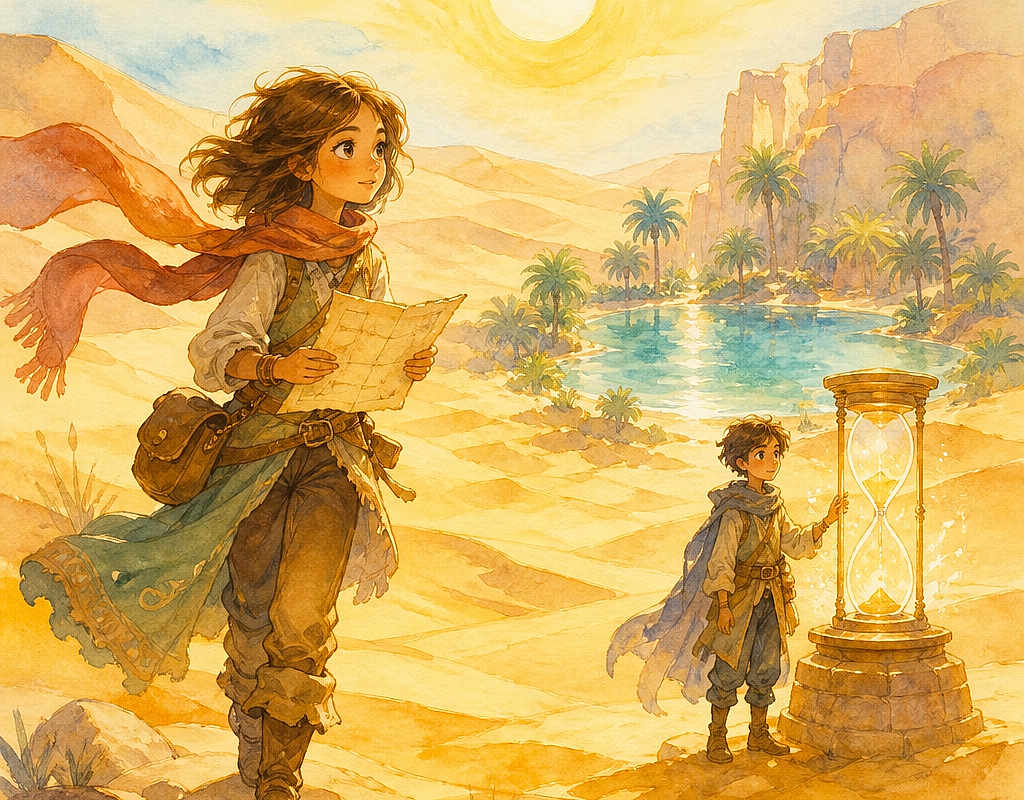
Gabby Keeton had always believed that maps were honest. A river on a map ran where it was drawn. A hill stayed politely round. An X meant treasure, or at least a very important place where someone had once spilled ink.
Then, on the hottest afternoon of the summer, she found a map that disagreed.
It lay inside a tin box beneath the loose floorboard of her grandmother’s desert cottage, folded into a square no bigger than her palm. When Gabby opened it, the paper stretched itself with a dry whisper. Blue lines flowed across it. Tiny palm trees sprouted in green ink. At its center shone a silver oasis, circled by words written in uneven, hurried letters:
THE HIDDEN OASIS. ENTER ONLY WHEN THE SUN FORGETS TO MOVE.
Gabby read the sentence three times.
“Sunsets happen every day,” she murmured. “The sun is not exactly forgetful.”
At that moment, the brass clock on the wall stopped ticking.
Outside, a lizard froze halfway across the doorstep. A bead of sweat hung beneath Gabby’s chin and refused to fall. The bright sun remained nailed to the exact same patch of blue sky.
The sun had forgotten to move.
Gabby was not the sort of girl who rushed into mysteries without a plan. She was curious, yes, but cautiously curious. She packed water, dates, a compass, a coil of rope, her grandmother’s old magnifying glass, and the map. She also packed three honey biscuits, because bravery was easier after a snack.
The map warmed in her pocket and tugged her toward the dunes.
Beyond the cottage, the desert was usually a wide kingdom of gold and wind. Today it was still as a painting. Gabby climbed the nearest dune, her boots sinking into warm sand. At its far side, where there should have been only more dunes, stood an archway woven from thorny vines.
A painted wooden sign hung over it.
HIDDEN OASIS. PLEASE DO NOT FEED THE CLOCKWORK FISH.
Gabby raised an eyebrow. “That is very specific.”
She stepped through.
Cool air embraced her at once. The Hidden Oasis spread below in a deep bowl between cliffs, so green and shining that it seemed impossible it had been hiding inside the desert. Date palms bent over clear pools. Terraces overflowed with mint, orange trees, and bright purple flowers. Waterfalls streamed down the stone walls, yet their droplets hovered halfway down, twinkling like glass beads. In the central lake, silver fish moved backward through the water. Above them, dozens of small clocks floated among the reeds, their hands spinning in different directions.
And beside the lake, standing knee-deep in the shallows, was a man in a sun-faded coat with more pockets than any coat truly needed.
He wore a wide hat, carried a shovel strapped across his back, and was arguing with a parrot made of brass.
“I told you, Captain Click, it was not a trap,” he said.
The brass parrot clicked its beak. “It had spikes, a pit, and a sign saying DO NOT STEP HERE.”
“Exactly! An obvious trap. Therefore, not a surprising trap.”
The man spotted Gabby and tipped his hat. “Excellent. A witness. I am Rook Bellweather, treasure hunter, explorer of difficult places, survivor of seven collapsing temples and one very determined goose.”
“I’m Gabby Keeton,” she said. “Why are you in the oasis?”
Rook’s cheerful expression faded. He pointed to the hovering waterfalls. “Because time has caught a thorn in its sock.”
“That does not explain much.”
“It explains more than you might think.”
Before Gabby could reply, a blue flash opened above the lake. It unfolded like a paper flower, and out tumbled a girl about Gabby’s age, though she wore an odd jacket stitched with tiny bronze buttons and a pair of goggles on her head. She landed in a reed bed with a splash.
“Wrong Tuesday!” the newcomer cried. “Or possibly right Tuesday, disastrously early.”
She rose, dripping and grinning despite herself. “Hello. I’m Tavi. Time traveler, certified amateur, currently stranded in a year that has a very rude attitude toward clocks.”
“You are a time traveler?” Gabby asked.
“Usually. At the moment I’m more of a time arrive-er.” Tavi looked at the motionless sun beyond the cliffs and groaned. “Oh no. The Still Hour has begun.”
Rook leaned on his shovel. “We had guessed as much. The great question is why.”
A voice answered from the shade of the oldest palm tree.
“Because someone believes time is safer in a cage.”
An elderly woman emerged, leaning on a cane carved with symbols of moons, waves, and turning gears. Her silver braid fell almost to her waist, and her robe had so many embroidered pockets that she seemed to have borrowed Rook’s tailor. On her shoulder sat a sandy-colored owl with enormous solemn eyes.
“I am Sage Namarra,” she said. “Keeper of the Oasis Almanac and, until today, guardian of the Hourglass Heart.”
Gabby glanced around. “Until today?”
Namarra’s owl made a worried hoot.
“The Hourglass Heart has been stolen,” said the Sage. “It rests beneath the oasis, where it balances the rhythm of this hidden valley. Its top chamber holds a grain of dawn, its bottom chamber a grain of dusk. As they pass through its narrow center, every moment learns how to become the next one.”
Tavi nodded grimly. “Without it, time does not stop everywhere at once. It snarls. Here a second may take years. There an hour may vanish before you blink.”
Rook’s face brightened in spite of the danger. “And where there is an ancient magical object, there is often—”
“No,” said Namarra.
“—a valuable historical lesson.”
“Better.”
“Who stole it?” Gabby asked.
Namarra looked toward the black cliffs on the oasis’s eastern edge. “Wizard Ormond Vell.”
Even the brass parrot lowered its metal wings.
“Is he evil?” Gabby asked.
“Not in the simple storybook way,” Namarra replied. “That would be easier. Ormond is brilliant, lonely, and terribly afraid. His village was swept away years ago by a flash flood that came without warning. Since then, he has tried to command every change he cannot predict. He built machines to trap storms, bottles to capture echoes, and clocks that scold people for being late. Today he has taken the Hourglass Heart to the Tower of Unfinished Tomorrows.”
“The black cliffs?” said Rook.
“The very same.”
Gabby studied the frozen waterfalls and backward-swimming fish. A strange weight settled in her stomach. If the oasis remained trapped, what would happen to the desert outside? Her grandmother? The small lizard on the doorstep, forever caught mid-step?
“What do we need to do?” she asked.
Namarra’s eyes softened. “Solve the Time Puzzle before the Still Hour seals completely. Ormond’s tower can be opened only by three keys: a memory freely given, a moment honestly faced, and a future willingly shared. No lockpick, no spell, no amount of digging will replace them.”
Rook coughed. “What if the digging is exceptionally tasteful?”
“No.”
Gabby unfolded her map. New ink was creeping across it, drawing a route through the oasis. At the end, a narrow path led toward the cliffs.
“I’ll go,” she said.
Tavi adjusted her goggles. “I’m coming. If time breaks badly enough, I may be erased from my own breakfast. I like breakfast.”
Rook swung his shovel off his back. “And I, naturally, am joining for the historical lesson.”
Captain Click squawked, “Treasure!”
“Quiet,” said Rook.
Namarra placed three objects on a flat stone: a green thread, a small mirror, and a paper seed folded from gold-speckled parchment.
“The Thread of Then, the Mirror of Now, and the Seed of Next,” she said. “They will recognize the keys when you find them. But remember: tools can guide you. They cannot choose for you.”
Gabby tucked the objects safely away. “Will you come too?”
“I must hold open the oasis’s remaining paths. The Still Hour is closing them one by one.” Namarra touched Gabby’s shoulder. “You are cautious, Gabby Keeton. Some people mistake caution for fear. They are wrong. Caution notices what courage must protect.”
Gabby had not realized how much she needed to hear that.
Their first path wound through the Garden of Repeated Mornings. Every few steps, the garden reset. A dew drop climbed back onto a leaf. A bee flew backward into a blossom. The same robin began the same note again and again, never reaching the end of its song.
At the far gate stood a stone pedestal with a shallow hollow shaped like a hand. Above it was carved: GIVE WHAT YOU KEEP, AND THE PAST WILL LET YOU PASS.
Rook rubbed his chin. “A memory freely given.”
“Could we tell it a memory?” Tavi asked.
Gabby placed the green Thread of Then in the hollow. It curled around her fingers, warm and insistent.
“I think it needs a real one,” she said.
Rook looked suddenly uncomfortable. He opened one of his countless pockets, removed a tarnished coin, and turned it over. “I have plenty of memories,” he said lightly. “Mostly involving excellent escapes.”
Captain Click peered at the coin. “Tell the sad one.”
Rook gave the parrot a betrayed look. “You are supposed to be my companion.”
“I am made of brass. I am incapable of pretending badly.”
For a while, only the repeating robin sang its unfinished note.
Then Rook laid the coin on the pedestal. “This belonged to my sister, Mara. When we were children, she wanted to explore ruins with me. I said she was too young and would slow me down. The next morning, she left for the capital to study engineering. I was proud of her, but I was too stubborn to say goodbye.”
The coin began to shine.
“I have found vaults full of jewels since then,” Rook continued quietly. “But I never found another chance to tell her I was wrong. That is the memory I keep turning over, as if I can polish it into a different ending.”
The garden went still, but not in the frightening way of frozen time. The bee settled on a flower. The robin completed its song, a clear bright melody. The gate opened.
Rook snatched up the coin. “Well. That was unpleasantly effective.”
Gabby did not tease him. “Maybe you can still write to her.”
Rook looked surprised. “You think so?”
“I think someone who studies engineering probably appreciates a good map.”
His smile this time was small, but real.
Beyond the garden lay the Canyon of Almosts. Its walls rose in bands of red, violet, and blue stone. In the air above the canyon, scenes flickered like windows: Tavi as an old woman sitting beneath a clock tower; Tavi as a captain steering an airship; Tavi as a tiny child holding someone’s hand. Each picture vanished before Gabby could understand it.
Tavi stared upward, suddenly pale.
“This place is showing possible futures,” she whispered. “That one is mine. Or might have been. Or will be. Time grammar is awful.”
The route ended at a bridge made of translucent glass. Halfway across, it disappeared. A carved sign read: ONLY THE PRESENT CAN BE CROSSED.
“The moment honestly faced,” Gabby said.
Tavi stepped toward the bridge and stopped. “I can do impossible things with my chronometer. I can jump five minutes forward, or skim backward across a day. But I keep using it to avoid things.”
“What things?” Gabby asked.
Tavi laughed once, without humor. “Embarrassing conversations. Decisions. Saying goodbye before I travel. If I can always leave a minute earlier, I never have to stand still long enough for anyone to matter.”
The Mirror of Now slid from Gabby’s pocket and floated before Tavi. Its surface did not show her face. It showed a crowded workshop where a younger Tavi stood beside an older woman with the same bright eyes.
“Your grandmother?” Gabby asked.
Tavi nodded. “She built the first time compass. She told me time travel was not about escaping the present. It was about understanding that every present becomes someone’s past.”
In the mirror, the grandmother held out a hand. Young Tavi hesitated, then ran away into a glow of blue light.
“I didn’t say goodbye,” Tavi said. “I thought I could visit any time. But then the compass fractured, and I couldn’t find my way back.”
She pressed both palms against the mirror. “I am here now. I am scared that I’m lost. I’m scared I wasted the last ordinary day I had with her. And I am tired of pretending that jumping away is the same as being brave.”
The glass bridge grew another panel, then another, until it reached the far side.
Tavi inhaled shakily. “I still hate bridges.”
“Reasonable,” said Gabby. “They are mostly holes with opinions.”
Tavi barked out a laugh. Together they crossed.
On the other side, the canyon narrowed into a tunnel. The air smelled of rain, though no rain had fallen in the desert for months. From deep underground came a slow, heavy ticking.
Tick.
Tick.
Tick.
Rook stopped so abruptly that Gabby nearly walked into him. “That is not a clock,” he said.
“What is it?”
“A giant clock pretending not to be a clock.”
The tunnel opened into a vast cavern. Gears larger than houses turned in the walls, though some had jammed under piles of black crystal. A river of glowing sand poured through channels on the floor. At the center stood the Tower of Unfinished Tomorrows, built from dark stone and countless clock faces. Some showed midnight, others noon, others impossible times: thirteen o’clock, yesterday-and-a-half, quarter past never.
At its entrance waited Wizard Ormond Vell.
He was taller than Gabby expected, dressed in a deep blue robe stitched with silver lines that pulsed like lightning. His beard was narrow and carefully braided. Around his wrists spun six tiny clocks, each ticking at a different speed. He did not look like a monster. He looked exhausted.
“Three children and a man carrying a shovel,” he said. “Namarra’s final defenders are becoming imaginative.”
“I’m not a child,” Rook protested.
Ormond blinked. “Then the shovel is worse than I thought.”
Gabby stepped forward before Rook could answer. “Give back the Hourglass Heart.”
“No.”
The plainness of his reply startled her.
“Time is breaking,” she said.
“Time breaks people,” Ormond replied. His voice echoed through the cavern. “It steals houses with floods. It carries friends away on ships. It takes a perfect morning and turns it into a memory before you have noticed it is precious. I am not breaking time. I am preventing it from taking anything else.”
He lifted a hand. The tower doors opened behind him, revealing the Hourglass Heart suspended in a web of blue light. It was beautiful: clear crystal, filled with a grain of gold above and a grain of violet below. Between them, a thin stream of shimmering sand had nearly stopped.
“If I hold the Still Hour,” Ormond said, “nothing changes. Nothing is lost.”
“Nothing grows either,” Gabby said.
Ormond’s eyes sharpened. “A simple answer.”
“Not simple,” she replied. “Just true.”
With a flick of his fingers, he sent a wave of blue light toward them.
Tavi grabbed Gabby’s arm. “Run!”
The light struck the ground, and the moment around it repeated: a pebble fell, bounced, rose, and fell again. Rook leaped aside, but Captain Click was trapped in the loop, flapping up and down in the same panic forever.
“Captain!” Rook shouted.
Gabby pulled the rope from her pack. She tied one end around a gear tooth and threw the other toward the brass parrot. It passed through the looping light, but the rope kept moving because it was anchored outside the spell.
“Grab it!” she called.
On the fourth repeated flap, Captain Click caught the rope in his beak. Gabby and Rook hauled together. The parrot burst free, squawking, “I demand hazard pay!”
Ormond watched Gabby with reluctant interest. “Ingenious. You see the edges.”
“She does,” said Tavi.
Ormond’s hand rose again. “Then you will see why this is necessary.”
The cavern vanished.
Gabby stood in a small village square under gray rain. Water thundered through the streets. People shouted and ran. A younger Ormond, perhaps twelve years old, clung to the hand of a woman in a red scarf. A wall of floodwater crashed around the corner.
“Mother!” young Ormond cried.
The woman pushed him onto the roof of a cart. “Hold on!”
Then the water took her away.
Gabby knew it was an illusion, but grief pressed against her chest as if it were real. She could not look away from the boy’s face.
The vision snapped back to the cavern. Ormond stood rigid, his expression guarded.
“I had one moment with her,” he said. “One moment to choose something clever enough, quick enough, powerful enough. I chose nothing. I was a frightened boy.”
“You were a frightened boy in a flood,” Gabby said softly. “That wasn’t your fault.”
His jaw tightened. “Pity does not repair a past.”
“No,” she said. “But trapping everybody in it won’t either.”
For an instant, his clocks faltered.
Then a harsh alarm rang from the top of the tower. The Hourglass Heart’s stream narrowed to a single trembling thread.
Tavi looked up. “We are out of time. Literally, which I hate.”
A panel opened in the tower wall, revealing three empty sockets: one shaped like a thread, one like a mirror, and one like a seed.
“The keys,” Gabby said.
They raced for the entrance. Ormond raised both hands, and the floor between them became a maze of moving gears. Rook hurled his shovel across a gap and used it as a lever to jam two gears apart.
“Go!” he cried. “I have always wanted to do that!”
Gabby and Tavi ran over the shovel handle. Captain Click flew ahead, calling directions in a terribly bossy voice. Ormond’s magic snapped at their heels, turning seconds into sticky ribbons that tangled around their boots.
Gabby pulled the green thread from her pocket. It glowed, then stretched behind them. The Thread of Then wrapped around the ribbons of frozen seconds and unraveled them, reminding them that every trap had a before, and therefore could have an after.
They reached the tower doors.
Inside, the tower was larger than the cavern should have allowed. Stairs spiraled through stars and storm clouds. Doors opened onto possible rooms: a library full of books that had not been written yet, a dining hall where future birthdays waited with unlit candles, a nursery where a wooden horse rocked by itself.
At the top stood the Hourglass Heart. Beneath it, a circular lock held the three empty sockets.
Gabby placed the Thread of Then in the first one. It dissolved into green light.
Tavi placed the Mirror of Now in the second. It flashed, and for a heartbeat Gabby saw herself reflected: dusty, worried, and far braver than she felt.
The third socket waited for the Seed of Next.
But as Gabby lifted it, Ormond appeared at the foot of the final stairs. His robe was torn. One of his wrist-clocks had stopped.
“Do not,” he said.
Rook stood behind him, holding the shovel like a staff, but he did not attack. Neither did Tavi. The wizard looked less dangerous now than desperate.
“The future cannot be trusted,” Ormond said. “You offer a seed to something that may never bloom.”
“That’s what a seed is,” Gabby replied. “A chance, not a promise.”
“Exactly. And chances fail.”
Gabby thought of Rook’s coin, Tavi’s grandmother, Namarra holding the paths open alone. She thought of her own grandmother’s cottage, and the stopped clock on its wall. She was afraid too. She could not promise that floods would never come, that goodbyes would not hurt, or that every careful plan would work.
But she knew that stillness was not safety.
“You can’t make the world harmless,” she said. “You can only make sure people don’t have to face it alone.”
Ormond’s expression changed, just slightly.
Gabby held out the paper seed. “You said you had one moment with your mother. That moment is gone. I’m sorry. But you have this one. You can choose what it becomes.”
The tower groaned. Cracks of blue light raced across the walls. Outside, the giant gears screamed as they seized.
Tavi whispered, “Gabby, now.”
Yet Gabby waited.
At last, Ormond climbed the final steps. His fingers trembled as he reached toward the seed. Gabby thought he might snatch it away.
Instead, he placed his hand beneath hers.
“Together,” he said.
They set the Seed of Next into the socket.
The lock turned.
The Hourglass Heart began to pour.
At first, only one grain of dawn slipped through its narrow center. Then the violet grain rose from below, not falling but climbing, until dawn and dusk met in a bright spinning spiral. The tower filled with wind. Every clock face chimed a different note, and somehow the notes became music.
The Still Hour shattered.
Not into broken pieces, but into motion.
Water thundered down the oasis waterfalls. The silver fish leaped forward through the lake. Far above, the sun moved at last, sliding toward afternoon. The cavern gears spun smoothly, carrying their rivers of glowing sand into the deep machinery of the world.
Gabby fell to her knees, laughing in relief.
Then the tower began to collapse.
“Of course it is,” Rook said. “Temples do love a dramatic farewell.”
Ormond stared at the falling stones. “The Heart is waking too fast. The tower was built to contain the pause. If it falls onto the gearworks, the oasis will flood.”
“We need to get everyone out!” Tavi shouted.
“No,” Ormond said, looking at the glowing channels beneath the stairs. “We need to redirect the sand.”
Rook grinned fiercely. “At last. A problem that respects a shovel.”
They raced downward. Ormond used his spell to hold falling beams in the air for precious seconds. Tavi flicked open her fractured chronometer and skipped herself across gaps, appearing first on one side, then another, tying Gabby’s rope around valves. Gabby read the moving pattern of the gears, noticing where the sand was piling up and where an empty channel could carry it away.
“Rook!” she shouted over the roar. “That wheel needs to turn left, but the crystal is blocking it!”
Rook swung his shovel. “Captain Click, count to three!”
“One!” shouted the parrot.
Rook braced his boots.
“Two!”
Ormond sent a burst of wind against the wheel.
“Treasure!” Captain Click yelled.
“That is not three!” Rook roared, but he heaved anyway.
The black crystal cracked. Gabby yanked the rope. Tavi twisted a valve at exactly the right instant. The wheel lurched left, and the glowing sand rushed into the empty channel.
The tower stopped falling.
For a few breathless seconds, everyone listened.
The gears turned.
The water flowed.
The world continued.
At the cavern entrance, Sage Namarra waited beneath a newly moving waterfall. Her owl circled overhead, hooting so loudly that Captain Click shouted back in offended competition.
“You solved the Time Puzzle,” Namarra said.
“We nearly got flattened by it,” said Rook.
“An important distinction,” Namarra agreed.
Ormond stepped forward, no longer wrapped in angry blue light. “The fault was mine. I will repair what I have damaged.”
Namarra studied him. “Repair is slow work.”
“I know.” He looked toward the oasis, where a tiny clock had fallen into the reeds and was ticking normally at last. “I am beginning to understand that slow is not the same as hopeless.”
The Sage nodded. “Then you may begin tomorrow. Today, you will help clean the clockwork fish pond.”
Ormond looked alarmed. “The sign says not to feed them.”
“It says nothing about cleaning.”
For the first time, the wizard smiled.
That evening, the Hidden Oasis held a celebration beneath lanterns made from moonlit shells. The palms rustled in a warm breeze. Musicians played drums and reed flutes. The silver fish performed backward flips, which were apparently their idea of dancing.
Rook received a polished brass compass from Namarra. Its needle did not point north. Instead, it pointed toward the person he most needed to find.
“It will lead you to Mara,” the Sage said.
Rook gripped it so tightly that his knuckles whitened. “I suppose I should learn to write first.”
Captain Click tapped his beak. “Dear Mara. Rook is sorry. Also rich.”
“Not helpful,” said Rook, though he was smiling.
Tavi received a new casing for her chronometer, carved from oasis crystal. When she held it, the broken blue light inside steadied into a soft pulse.
“It will not take you anywhere you wish,” Namarra warned. “But it may take you where you are ready to go.”
Tavi swallowed. “That sounds annoyingly wise.”
“It is my profession.”
Then Namarra turned to Gabby.
The Sage placed a small cedar chest in her hands. Its lid bore an X inside a circle. When Gabby opened it, she found not gold coins, but something even more astonishing: twelve slim sheets of silver-blue paper, each blank except for a border of tiny stars.
“Maps?” Gabby asked.
“Unmade maps,” said Namarra. “They draw themselves when a true explorer needs them. Each will show a hidden place only to someone who travels with care, curiosity, and kindness.”
Gabby touched the first page. A faint line appeared, leading from the oasis toward a mountain shaped like a sleeping lion.
Rook leaned over her shoulder. “That looks promising.”
“It looks dangerous,” Tavi said brightly.
“It can be both,” Gabby replied.
At last, she returned through the vine archway with the unmade maps in her pack. The desert wind was blowing again. At her grandmother’s cottage, the lizard completed its journey across the doorstep and looked at Gabby as if no time at all had passed.
Inside, the brass clock ticked.
Her grandmother was sitting at the kitchen table, pouring mint tea. She looked up, took in Gabby’s dusty boots, rope, and windblown hair, then glanced at the cedar chest.
“Did the floorboard give you trouble?” she asked.
Gabby stared. “You knew about the map?”
Her grandmother’s eyes sparkled. “I knew it was waiting for the right person.”
“Did you go to the Hidden Oasis too?”
“Once,” her grandmother said. “A long time ago. I was given one of those maps.”
Gabby set the chest carefully on the table. “What did yours lead to?”
Her grandmother smiled into her tea. “That is a story for another afternoon.”
Gabby wanted to ask a hundred questions. Instead, she poured herself a cup and watched the last light turn the desert dunes orange beyond the window. The day was moving again. It was not frozen, perfect, or safe from surprises.
It was alive.
And tucked beneath her hand, the first unmade map drew one more silver line.
It led onward.
Gabby smiled.
She had never believed maps could lie again.
But she had learned something better: the finest maps did not lie at all. They simply waited for brave, careful people to help finish them.