
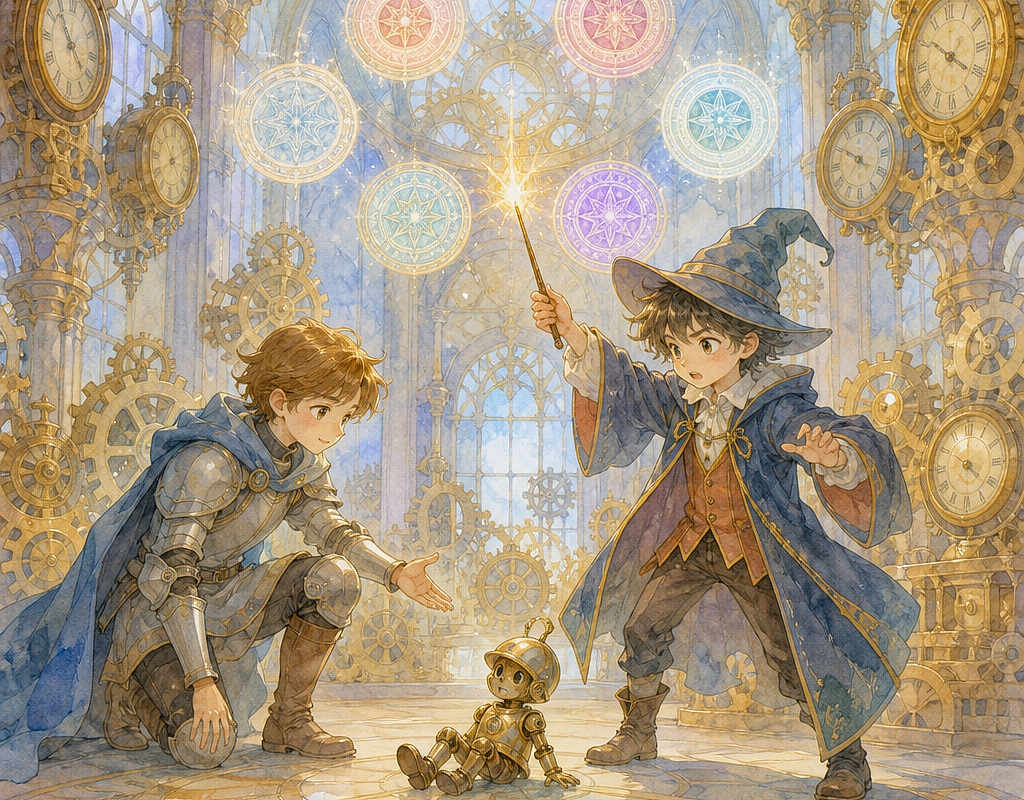
On the highest hill above the city of Merrow, where three silver roads met beneath a sky crowded with moons, stood Spellcasters Hall. It was not a school in the ordinary sense. Its towers changed places when nobody was looking, its windows displayed tomorrow's weather only after it had happened, and its vast bronze doors opened only for those who could answer one question: “What is magic for?”
Most visitors tried to sound clever. “To become powerful,” said one. “To find secret things,” said another. “To turn vegetables into cake,” said a hungry apprentice.
But the doors had opened for Knight Hero of All Who Need His Help when he had answered, “Magic is for helping, if helping is what is needed.”
It was a cumbersome name, especially when engraved across the breastplate of his armor. The letters curled from shoulder to shoulder in bright blue enamel. Children in the city called him Hero for short. Adults did too, though not always when he could hear them. Hero did not mind. He had earned the name after spending years carrying lost travelers over flooded roads, mending village gates, chasing away bandits without taking their lunch money, and once climbing a chimney to rescue a stubborn kitten that had been hiding there perfectly safely.
Hero was young for a knight, broad-shouldered but not boastful, and he had a habit of listening so carefully that people sometimes told him things they had not planned to say. His sword, Dawn-Reply, rested in a blue scabbard at his hip. It was a fine sword, but Hero preferred using it to cut ropes, pry open jammed doors, and point at maps. He believed that a blade should be the last answer, not the first.
On the morning that changed Spellcasters Hall forever, Hero was polishing rain from his helmet in the Hall's long gallery. Outside, a storm had rolled around the hill all night, rattling the copper roofs. Inside, hundreds of candles drifted in the air, their flames shaped like tiny golden birds.
A sharp voice said, “If you polish that helmet any more, it will become a second moon and disrupt the tides.”
Hero looked up. At the far end of the gallery stood Spellcaster.
That was truly his name. He had been born during a meteor shower, and his parents, who had both been wizards with very little imagination, had named him Spellcaster. He was the Hall's youngest Master of Practical Enchantments, though he insisted he was not young, merely “chronologically underestimated.” His dark green robes were lined with pockets, and every pocket held something impossible: a spoon that predicted arguments, chalk that wrote rude comments on blackboards, a small cloud that rained only on his left shoe, and a brass compass whose needle pointed toward the nearest mystery.
Spellcaster had a narrow face, alert gray eyes, and ink stains across his fingers. He could make a staircase grow wings, convince a thunderstorm to whisper, and brew a tea that helped people remember dreams. Yet, despite all this talent, he became impatient whenever things refused to fit into a clear explanation.
Hero smiled. “Good morning, Master Spellcaster.”
“Not good,” Spellcaster said. “Not remotely good. Come quickly.”
He marched down the gallery, his left shoe receiving a small but determined rainstorm. Hero fastened his helmet and followed.
They descended through the Hall's oldest corridors. Stone gargoyles leaned from the ceilings, whispering arithmetic to each other. Doors labeled CLOUD STORAGE, POLITE DRAGONS ONLY, and DO NOT OPEN DURING AN ECLIPSE slid past. At last Spellcaster stopped before a circular chamber under the central tower.
In the room's center stood the Heartwork Engine.
It was a machine taller than a house, made of crystal pipes, gold gears, and a spinning wheel of blue light. The Engine had been built by the founders of Spellcasters Hall long ago. It did not create magic; nobody could do that. It helped the Hall guide magic safely, like riverbanks guiding a river. Its steady humming kept the towers from wandering too far, the enchanted books from biting their readers, and the weather inside the greenhouses from becoming overly emotional.
Usually the Heartwork Engine sang a calm, deep note, almost too low to hear.
Today it screamed.
Red sparks snapped from its pipes. Gears spun backward. A brass bell at the top clanged wildly, and the blue light in the wheel had turned the color of storm clouds.
Hero took one step toward it.
“Careful!” Spellcaster cried. “It is leaking reversal magic.”
As if to prove him right, Hero's cloak flew up over his face. His boots tried to walk backward. One of the candles near the ceiling became a blob of wax and then a candle again.
“What happened?” Hero asked, wrestling his cloak down.
Spellcaster held up a tiny object between thumb and forefinger. It was a wind-up toy soldier, no taller than a finger. Its painted red coat was chipped, its tin face wore a fierce scowl, and a key protruded from its back.
“This,” said Spellcaster.
The toy clicked its tin heels together.
“General Ticktock,” it squeaked. “Commander of the Grand Playroom Battalion. I demand respect, marching room, and at least one biscuit shaped like a star.”
Hero blinked. “This caused all that?”
“Do not judge an enemy by its height,” said the toy. “Some mountains are smaller than they appear.”
Spellcaster sighed. “It was found last night in the Hall's attic, among old enchanted objects. I brought it here to identify its magic. The moment I placed it beside the Engine, it sprang up, turned its key, and wound the Engine backward.”
“Not backward,” General Ticktock said. “Correctly. The world is terribly untidy. Every child abandons toys, every tower leans, every promise gets delayed. I will restore order. Everything will be wound, arranged, and made to obey its proper place.”
The toy's key turned with a harsh little whirr.
The Heartwork Engine gave another shriek. A crack of dark blue light split across its crystal wheel.
Then General Ticktock leapt from Spellcaster's hand, landed on a copper pipe, and scurried upward with astonishing speed.
“Stop him!” Spellcaster shouted.
Hero ran. He vaulted over a rolling gear, seized a hanging chain, and swung toward the Engine. The toy reached a small hatch just below the wheel. It saluted mockingly and disappeared inside.
A second later, the whole Engine lurched.
The floor became a slope. Books flew off shelves in the corridor. Somewhere above, a tower groaned and began to move.
Spellcaster grabbed Hero's arm. “The Engine's balance seals are reversing. If all seven turn, the Hall will become a Clockwork Dominion. Every enchantment here will follow a single command: perfect order.”
“That does not sound entirely terrible,” Hero said, bracing himself against the shaking wall.
Spellcaster stared at him. “Perfect order means no choices. No accidents, no surprises, no changes. It means every living thing must repeat the same action forever.”
From the corridor came a terrified yell. A student ran past them, repeatedly dropping the same stack of papers and repeatedly shouting, “Oh no!”
Hero's expression hardened. “Where are the seals?”
“One in each wing of the Hall. General Ticktock has sent clockwork toys to claim them. We must reach the central wheel after restoring all seven, or the Hall locks itself into the reversal forever.”
“Then we should hurry.”
Spellcaster looked toward the screaming Engine. “There is a complication.”
“There is always a complication.”
“The first seal lies in the Library of Unfinished Stories. It can only be restored by solving its riddle. The second is in the Greenhouse of Impossible Plants, which is currently growing metal vines. The third—”
Hero drew Dawn-Reply. Its blade shone warm gold. “We will start with the library.”
Spellcaster's face changed then. The impatient wizard looked almost relieved. “You do understand that we may fail?”
“Yes,” Hero said. “But somebody needs help.”
They raced into the Hall.
The Library of Unfinished Stories was normally a peaceful place, with soft sofas, warm lamps, and shelves that rose higher than trees. Today, it had become a battlefield of paper. Pages swarmed through the air like white birds. Ink dripped from the ceiling in black rain. The great double doors stood shut, bound with a ribbon of ticking silver thread.
On the doors appeared a sentence in glowing letters:
WHAT BELONGS TO EVERY STORY, YET CANNOT BE WRITTEN BY ANY AUTHOR?
Spellcaster snapped his fingers. “A conclusion.”
The doors did not move.
“A reader?” Hero suggested.
Nothing.
Behind them, a squad of wind-up wooden mice marched around a fountain, dragging a chain toward the doors. Each mouse wore a tiny brass helmet. General Ticktock's voice crackled from a little speaker in their leader's chest.
“Proceed, Battalion Nibble! Arrange all books alphabetically by first sentence! Eliminate ambiguity!”
Hero cut the chain with Dawn-Reply, but the mice immediately began tying it back together with threads from their own tails.
Spellcaster crouched, examined the riddle, and muttered, “Every story. Cannot be written. It is not an ending, because endings can be written. It is not a reader. A story needs—”
Hero watched a young apprentice frozen by a bookshelf. She was holding a book open. On every page, the hero of the tale was trapped at the edge of a cliff, unable to make a decision.
“What is wrong?” Hero asked her.
“I do not know what he should do,” she whispered. “The book will not continue until I choose.”
Hero looked again at the glowing question.
Then he smiled. “A choice.”
The silver thread unraveled. The doors opened.
Inside, dozens of unfinished stories had spilled from their books. A pirate with one purple boot argued with a dragon about a missing chapter. A queen sat on a staircase that ended in midair. A detective searched for clues to a mystery whose crime had not yet been invented.
At the room's center, above a desk covered in quills, floated the first balance seal: a round mirror of pale glass. It was almost entirely covered by mechanical spiders, each one stitching a rigid black frame across its surface.
“Do not let them finish,” Spellcaster said.
Hero moved toward the mirror, but several spiders dropped in front of him, their needle legs clicking. He raised his sword, then stopped. They were small, frantic, and clearly following a command.
“Spellcaster,” he said, “can you break the command without breaking them?”
The wizard looked surprised. “Perhaps. Keep them busy.”
Hero did something no knight in a ballad would have expected. He grabbed a loose pile of story pages and began reading aloud.
“In a city beneath the sea,” he announced, “there lived a spider who wished to build a sailboat—”
The nearest spiders paused. Their glassy eyes flickered.
“—but the spider had no sails, only silk. So it wove a sail finer than moonlight, and when the wind filled it—”
The spiders began climbing onto the pages. One tapped a needle leg against a sentence and added a comma.
Spellcaster whispered a complicated charm, drawing a circle in the air with blue chalk. The command symbols on the spiders' backs glowed red, then sputtered out.
The spiders tumbled free from the mirror. Instead of attacking, they hurried to the desk and began binding the loose stories into books.
The pale mirror brightened. Within it appeared a spinning silver arrow, which turned from backward to forward.
“One,” Spellcaster said.
The Hall shook. Far away, a bell rang in a different rhythm.
They ran next to the Greenhouse of Impossible Plants. On the way, they passed halls where portraits had started repainting their own faces as babies, kitchens where soup leapt back into vegetables, and staircases that forced everyone to descend while insisting they were climbing.
The greenhouse glass had gone black with vines. Huge stems of iron curled through broken panes. Their leaves were sharp clock hands, and their flowers were brass funnels that puffed out clouds of gray steam.
At the entrance stood three mechanical dolls with porcelain faces. Their painted smiles did not reach their eyes. Each held a gardening fork.
“Visitors must be planted,” said the tallest doll.
“Visitors must be watered,” said the second.
“Visitors must be sorted by height,” said the third.
Spellcaster murmured, “I dislike them.”
Hero stepped forward. “We are here for the balance seal.”
“Order requires roots,” said the tallest doll. “You will be planted.”
The dolls charged.
Hero parried gardening forks without striking the dolls themselves. He had fought ogres with clubs and wolves with teeth, but the dolls were swift, and their joints clicked with horrible precision. One fork hooked his shield. Another scraped sparks from his armor. Spellcaster threw a handful of luminous seeds, and they exploded into bouncing pumpkins that rolled beneath the dolls' feet.
The dolls slipped, spun, and collided in a clatter of porcelain.
“Nicely done,” Hero said.
“I had intended dignified vines,” Spellcaster replied. “The seeds interpreted the moment artistically.”
They entered the greenhouse. Every path had been overgrown by metal vines. In the center, the balance seal hung beneath a giant steel rose. The rose's closed petals wrapped around a golden crystal, while its thorny stem disappeared deep into the earth.
A low sound came from beneath the soil: crying.
Hero knelt beside the roots. “Can you hear that?”
Spellcaster pressed his palm to the ground. His brows drew together. “The greenhouse keeper. Mistress Alder. The roots have trapped her in the irrigation tunnels.”
The seal flashed, then dimmed further.
“We need the crystal first,” Spellcaster said. “If the Hall collapses, we cannot save anyone.”
Hero looked at him. “If we leave her, what kind of saving is that?”
The wizard's jaw tightened. For a heartbeat, he seemed ready to argue. Then he pulled out a small silver whistle. “You are inconveniently correct.”
Together they followed the sound through a narrow maintenance hatch. Below the greenhouse lay a maze of wet brick tunnels. Water flowed backward along channels in the floor. At the deepest junction, Mistress Alder was pinned under a lattice of iron roots. She was an elderly woman with a plaited white braid and mud across her spectacles. Even trapped, she was scolding the vines.
“You overgrown teaspoons! I fed you compost, not rebellion!”
Hero wedged Dawn-Reply between two roots and pushed. The blade groaned. Spellcaster traced runes in the air, trying to soften the metal. But the more they strained, the tighter the roots curled.
Mistress Alder drew a breath. “The rose is listening,” she said. “It wants to be useful. That is what makes it dangerous. Someone gave it an order to hold everything still, and it believes holding tightly is helping.”
Hero stopped pushing. He placed his hand against the cold root.
“You have done enough,” he said quietly. “Let her go.”
For a long moment, nothing happened.
Then the root beneath Hero's palm warmed. The iron vines loosened one by one.
Mistress Alder crawled free. Above them, the giant rose opened its petals with a shriek of metal. The golden crystal floated down into Hero's hands.
The second seal restored itself, its arrow turning forward. The steel rose did not vanish. Instead, it bent its flower head toward Mistress Alder like a ashamed pupil.
She patted one petal. “Tomorrow, we shall discuss boundaries.”
By dusk, they had restored four seals.
The third had been hidden in the Observatory, where a toy brass telescope had tried to lock the stars into a single unchanging pattern. Hero and Spellcaster freed the night sky by climbing the dome's moving rafters and returning each star to its own path. The fourth lay in the Hall of Echoes, where an army of jack-in-the-boxes had captured every sound. Hero defeated them not by force, but by persuading the loudest box to sing a ridiculous song about turnips until the others laughed themselves open. The fifth was beneath the practice arena, protected by a wooden marionette dragon. Spellcaster discovered its strings led not to General Ticktock, but to its own frightened heart. Hero cut only the cruelest string, and the dragon chose to help them.
Yet each victory made General Ticktock stronger.
The tiny commander had reached the Heartwork Engine's central wheel. Through speaking mirrors in the Hall, his voice issued commands.
“Citizens of Spellcasters Hall! Disorder is ending. Soon, no one will lose anything. No one will make mistakes. No one will have to wonder what comes next.”
Some students, exhausted and frightened, began to listen.
A boy whose spells often fizzled said, “It might be easier if everything had rules.”
A girl who had lost her favorite scarf whispered, “Then nothing bad could happen.”
Hero heard them as he and Spellcaster hurried toward the sixth seal, in the abandoned Wing of First Lessons. He did not blame them. General Ticktock's promise was tempting. A world without fear, without error, without sudden loss: who would not want that, especially after a day of collapsing towers and malicious dolls?
But Hero remembered the apprentice in the library, holding a story that could not go on without a choice. He remembered the steel rose, which had wanted so badly to help that it had hurt someone. And he remembered every person he had ever rescued, because rescue was never about making life perfectly safe. It was about standing beside someone when safety had failed.
The Wing of First Lessons had been closed for years. Its halls were lined with old training rooms, each built to teach a basic magical truth. One taught that fire could warm as well as burn. Another taught that words spoken carelessly could not always be gathered back. The sixth seal was kept in the Chamber of Lost Things.
As Hero and Spellcaster entered, the door locked behind them.
The room was enormous and dim, filled from floor to ceiling with objects that people had lost: single gloves, cracked spectacles, silver buttons, letters never sent, keys without locks, toy boats, an entire bicycle, and a small wooden crown.
At the far end sat General Ticktock on a throne of building blocks.
“You are late,” he said.
Spellcaster raised his wand. “You are finished.”
“Am I?” The toy turned his key. “Look around you.”
Hero noticed the objects trembling. Hundreds of lost things slid from their shelves and arranged themselves in orderly rows.
“Every one of these was abandoned,” General Ticktock said. His tin voice was still sharp, but something beneath it had changed. “Dropped. Forgotten. Replaced by newer, brighter things. I was once the favorite toy of a child named Lysa. She took me everywhere. She called me Captain, although I was only a soldier. Then she grew older. She stopped playing battles. One day, she put me in a chest and promised to return. She did not.”
He pointed one tiny sword at Hero.
“Do you know what it is to wait in darkness while years go by? To hear laughter above you and know it no longer belongs to you?”
Hero lowered Dawn-Reply.
Spellcaster whispered, “Hero, do not let him distract you. The seal is behind him.”
But Hero walked forward slowly. “I know what it is to be forgotten,” he said.
General Ticktock's painted eyes narrowed. “You? A knight everyone praises?”
“When I was small, I was not a knight. I was the youngest son in a crowded house. My brothers were clever and loud. I was neither. I used to stand in doorways, hoping someone would notice I had something to say.”
“What did you do?”
“I learned to listen. People notice you less when you are quiet. But they tell you more.”
The general's key slowed.
Hero continued, “Lysa should not have left you in the chest without a goodbye. But her growing up did not mean that you were worthless. It meant the game changed.”
“Easy for a human to say. You can choose a new game.”
“So can you.”
General Ticktock laughed, but it sounded like a gear catching on rust. “I chose one. I will make a world where nothing is ever left behind.”
“And in that world,” Hero asked, “will anyone be allowed to leave because they choose to? Will they be allowed to become different?”
The toy's tiny hand tightened on his sword.
A bell chimed somewhere beyond the walls. Six sharp notes. Then a seventh, lower and wrong.
Spellcaster went pale. “The final seal has started to reverse. We do not have time.”
General Ticktock sprang up. “No time is exactly what I intend to solve.”
The throne of blocks unfolded into a towering clockwork spider. It rose on eight legs, knocking shelves aside. General Ticktock sat inside its glass head, turning levers. The spider's pincers snapped toward Hero.
Hero rolled beneath the first strike. A pincer crushed a stack of old trunks, sending scarves and hats exploding into the air. Spellcaster fired a ribbon of blue light, but the spider reflected it from polished brass plates.
“Every machine has a weakness!” Spellcaster shouted.
“Then find it!” Hero called.
The spider attacked again. Hero leapt onto its leg, climbed as it bucked, and drove Dawn-Reply into a seam between plates. Not deeply enough to damage its workings, only enough to jam the joint. The leg bent sideways. The spider stumbled.
General Ticktock screeched. “Unacceptable imperfection!”
“Precisely,” Hero said.
The spider flung him across the room. He hit a mountain of cushions and landed beside a battered toy chest. On its lid, nearly faded, were painted words: LYSA'S BRAVE THINGS.
Inside lay a small cloth rabbit, a wooden horse, and a paper medal made with a child's uneven handwriting.
FOR CAPTAIN, WHO PROTECTED US FROM THE THUNDER.
Hero looked up. General Ticktock had raised the spider's pincer over Spellcaster, who was trapped beneath a fallen shelf.
“Captain!” Hero shouted.
The pincer paused.
“I found your medal.”
“Do not call me that!” General Ticktock yelled, but his voice broke on the last word.
Hero held up the paper circle. “Lysa did not forget what you did for her.”
The clockwork spider trembled. In its glass head, the toy soldier stared at the medal. Behind its furious painted expression, he seemed very small.
Spellcaster seized the moment. He thrust out his wand and said, “Unfasten, unbind, uncommand!”
The spider's gears sprang loose in a shower of harmless brass buttons. It collapsed into a heap. General Ticktock fell onto the floor, and his key spun wildly.
Hero caught him before he hit the ground.
For a moment, the toy struggled. Then he went still.
“I did protect them,” he whispered.
“Yes,” said Hero. “And you could protect others now.”
The sixth balance seal floated from behind the fallen throne. It was a crystal key, and as Hero touched it, the key glowed with a steady amber light.
General Ticktock looked at the seal, then at the paper medal in Hero's hand.
“The seventh seal is not in the Hall,” he said.
Spellcaster, freed from the shelf, stared. “What?”
“I removed it,” said the general. “Before you found me. It is in the Clockwork Vault beneath the hill. The Engine's roots lead there. Once the last turn completes, the vault will close forever.”
“Why tell us?” Spellcaster asked suspiciously.
General Ticktock looked at the medal again. “Because a captain should not leave his soldiers in the dark.”
The path to the Clockwork Vault began beneath the Engine. Hero, Spellcaster, and General Ticktock descended through a narrow tunnel of rotating gears. The toy commander rode in Hero's breastplate pocket, where he gave directions with military seriousness.
“Left at the blue pipe. Do not touch the purple lever. It activates the emergency parade.”
“What is an emergency parade?” Spellcaster asked.
“No one knows. That is why it is an emergency.”
At the tunnel's end, they found a vast cavern under the hill. A river of liquid starlight ran through it. In the center stood the Clockwork Vault: a sphere of black iron suspended above the river by chains. Its surface was covered with thousands of ticking keys.
The seventh seal gleamed behind a narrow window in the sphere. It was a simple wooden wheel, no larger than Hero's hand.
Between them and the vault marched General Ticktock's entire remaining army: tin soldiers, dolls, mice, trumpeting toy elephants, and two toy cannon carriages that fired foam stars.
The army raised its weapons.
General Ticktock stood in Hero's palm. “Battalion,” he called.
The toys did not move.
“Commander?” squeaked a mouse.
The general faced them. “New order. No one is to be wound against their will. No one is to be discarded. And no one is to stop these two from saving the Hall.”
A porcelain doll tilted her head. “But orders are meant to be obeyed.”
General Ticktock looked toward Hero. Hero did not speak. He only waited.
At last the toy commander said, “Then this is not an order. It is a request. Will you help?”
For one quiet second, the cavern held only the ticking of keys.
Then the wooden mice cheered. The toy elephants trumpeted. The dolls lowered their forks. One cannon fired a foam star into the air, where it burst into a sparkling question mark.
“We will help!” they cried.
The vault's chains suddenly tightened. The sphere began to rise. Above them, the Heartwork Engine roared. The final reversal was beginning.
Hero ran across the nearest chain. Spellcaster followed, muttering a spell to make his robes stop tangling around his knees. The toy army swarmed after them. Mice climbed the links and jammed their teeth into tiny locking pins. Elephants pushed against the chain anchors. Dolls formed a ladder for Spellcaster when the chain swung beyond reach.
At the vault, Hero tried the iron door. It was sealed shut.
“Three keyholes,” Spellcaster said. “And we have no keys.”
General Ticktock leapt down. “We have keys.”
All across the sphere, thousands of winding keys turned. The little commander inspected them. “Each is connected to a toy's command spring. If we remove enough, the door will open. But the toys may lose their magic.”
The army had heard him. Fear flickered across painted and wooden faces.
Hero knew the choice was not his. He looked at them and said, “You have already done more than anyone could ask. I will find another way.”
“There is no other way,” Spellcaster said, his voice low.
A small mouse stepped forward. “If our magic helps save everyone, it is not being taken,” she said. “It is being used.”
The porcelain doll nodded. “I would rather choose one brave moment than march forever.”
One by one, the toys removed their keys.
They did not crumble. Instead, every key became a thread of warm light. The threads flew into the three keyholes, twisting together. The black iron door opened.
Inside the vault, the wooden wheel of the seventh seal spun backward faster and faster. It was connected to a vast pendulum that reached up through the cavern roof toward the Heartwork Engine.
Hero entered first. The floor tilted. Spellcaster cast an anchoring charm, but the backwards magic chewed through it like fire through paper.
“Turn the wheel!” Hero shouted.
“I am trying!” Spellcaster grabbed it with both hands. The wheel burned blue under his palms. “It is locked to the Engine's first command!”
General Ticktock stared at the mechanism. “The command is mine.”
“You can undo it?” Hero asked.
“I can speak it,” said the toy. “But I must mean it.”
The vault shuddered. Cracks opened in the iron walls. Beyond them, the starlight river began flowing upward in shining columns.
General Ticktock climbed onto the wheel. His painted red coat was chipped, his sword bent, his paper medal tucked beneath one arm. He placed both hands on the spinning rim.
“I commanded the world to hold still,” he said.
The wheel slowed slightly.
“I thought being needed meant never being allowed to change.”
The wheel slowed again.
“But a true captain does not trap his companions in yesterday.”
He looked at Hero, then at the waiting toys beyond the vault door.
“My command is ended. Choose your own next step.”
The wooden wheel stopped.
For half a breath, nothing happened.
Then it turned forward.
The seventh seal burst into gold light. The pendulum swung once, sending a ringing note through the cavern. Above them, the Heartwork Engine answered with its old deep hum.
The cracks sealed. The river settled. The towers of Spellcasters Hall stopped moving and, after some consideration, returned to sensible places.
In the silent vault, Spellcaster sank to the floor, laughing with exhaustion.
Hero picked up General Ticktock. The toy's keyhole was empty. His arms and legs no longer clicked when he moved.
“Are you all right?” Hero asked.
General Ticktock flexed one tin hand. “I appear to be un-wound.”
Spellcaster looked closely, then smiled. “Not unwound. Changed.” He touched the toy lightly with one ink-stained finger. “The Heartwork Engine has shared its balance magic with you.”
General Ticktock's chest glowed faintly. A tiny rhythm pulsed inside him, not ticking, but beating.
When they returned to the Hall, the students filled the central gallery. They cheered so loudly that several portraits complained about the noise. Mistress Alder presented Hero with a wreath made of silver rose petals. The librarian gave Spellcaster a book that wrote new chapters whenever its owner asked a difficult question. And the former clockwork army was welcomed into the Hall, not as servants or weapons, but as citizens with very particular talents.
The wooden mice became expert repairers of tiny mechanisms. The porcelain dolls organized the lost-and-found, though they politely asked permission before sorting anything by height. The toy elephants hauled heavy books. The marionette dragon guarded the practice arena and accepted payment in polished buttons.
As for General Ticktock, he chose a new title.
“Captain of the Hall's Rescue Cabinet,” he announced from a little platform in the entrance gallery. “We will assist lost toys, frightened children, misplaced homework, and anyone requiring strategic encouragement.”
His first recruit was the cloth rabbit from Lysa's chest. His second was a teacup that had spent forty years pretending not to be lonely.
A week later, the bronze doors of Spellcasters Hall asked Hero their ancient question again.
“What is magic for?”
Hero stood beside Spellcaster, who was carrying a small cloud in a jar, and Captain Ticktock, who was wearing his paper medal under a newly polished red cape.
Hero considered all that had happened: the fear behind the general's anger, the courage of the toys, the choices made by people who could have obeyed but chose to help instead.
“Magic is for helping,” he said, “but helping means listening first. Otherwise, even a kind intention can become a cage.”
The doors opened wide.
Behind them waited a surprise from the Hall's grateful masters: a new chamber, bright with maps and polished armor stands. Above its entrance shone a name in blue enamel.
THE HERO'S WORKSHOP.
Inside were treasures beyond Hero's expectations: a shield that could become a bridge, boots that never slipped on ice, a lantern that revealed safe paths in fog, and a compact tool case filled with enchanted rope, lockpicks for friendly emergencies, and a little brass whistle that summoned the Rescue Cabinet wherever help was needed.
Hero ran his fingers over the shining shield. Then he looked at his friends.
“Where do we begin?” he asked.
Captain Ticktock saluted. Spellcaster's compass needle spun, then pointed toward a distant window where storm clouds were gathering over the northern road.
Spellcaster grinned. “Somewhere, undoubtedly, there is a complication.”
Hero fastened the new shield to his arm. “Then someone may need us.”
Together, knight, wizard, captain, and the first brave volunteers of the Rescue Cabinet stepped through the Hall's bronze doors. The hill wind caught Hero's cloak, the storm rumbled like an invitation, and far below, the silver roads led outward into a world that was imperfect, surprising, and gloriously free to choose what came next.