
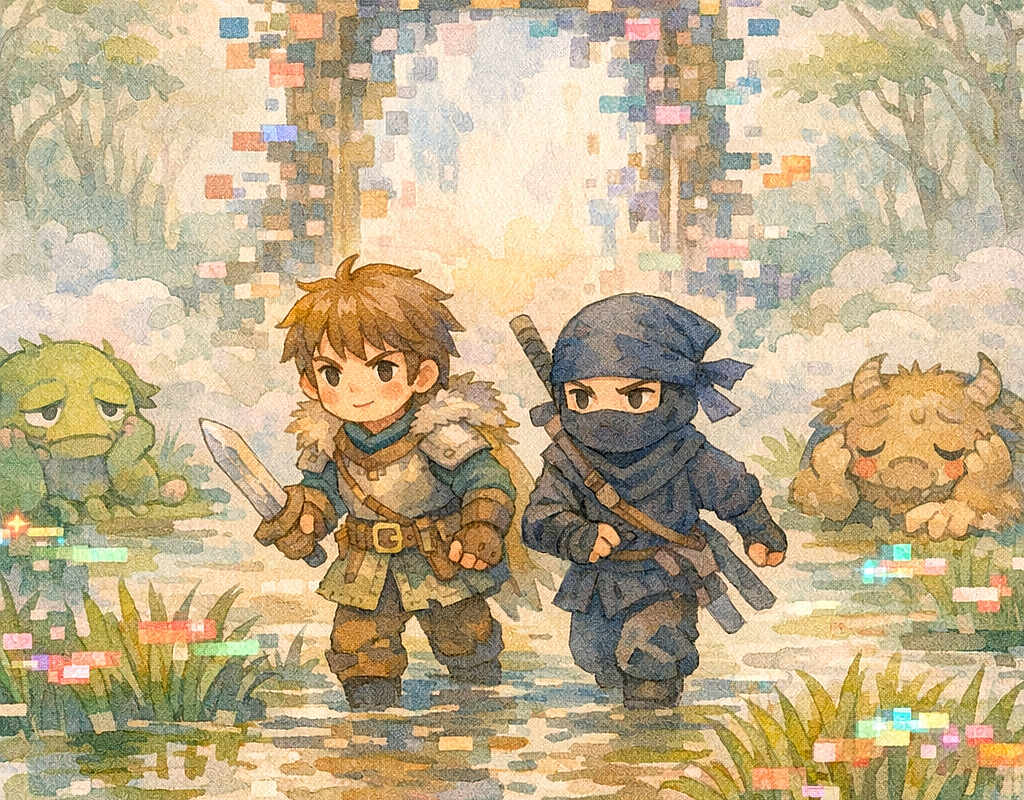
In the Game World, the sky wasn’t really a sky at all. It was a giant dome of shifting pixels, like a quilt stitched from sunsets, thunderstorms, and the faint glow of loading screens. If you listened closely, you could hear the soft click of distant menus opening, the whisper of quests being accepted, and the gentle hum of a thousand hidden engines keeping the world running.
Thomas the monster slayer lived on the edge of the Starter Village, in a small house built from polished stone blocks and warm wooden panels. People called him a Superhero, but not the kind who posed for statues or demanded applause. He was the kind who fixed problems that others were too scared to even name.
He wore a cape that looked simple until it caught the light—then you could see tiny stitched icons along the hem: shield symbols, tiny stars, and a threadwork map of the village. Around his wrist he kept a band of braided cords, each one a reminder of a promise he had made to someone: to protect, to listen, to return.
Thomas was brave, yes. But his bravery didn’t feel loud. It felt careful.
He had a habit of pausing before every fight, not because he was afraid of danger, but because he believed danger was always trying to say something. He wanted to understand it first.
That morning, he stepped into the village square and immediately knew something was wrong.
The Market Board—an enormous wooden sign where daily missions appeared—was blank.
No notices.
No colorful icons.
No cheerful “Find five mushrooms” or “Deliver bread to the baker.”
Just smooth, empty wood, as if someone had wiped the day clean.
A crowd had gathered. The blacksmith, who usually complained that quests were “too easy these days,” stared at the board as if it had insulted him personally.
The librarian muttered, “That’s not possible. The system doesn’t… forget.”
A small kid tugged Thomas’s cape. “Sir Thomas? If there are no quests… does that mean the game is broken?”
Thomas crouched so he could meet the kid’s eyes. “It means something important is hiding. And hiding things usually means they’re scared.”
The kid frowned. “Or sneaky.”
Thomas gave a quick grin. “Or both.”
A quiet movement slid through the crowd like a shadow slipping between feet. Someone bumped Thomas’s shoulder, and before he could turn, a figure was already behind him.
A Ninja.
Not a noisy one, not the dramatic kind who announced themselves with smoke bombs. This Ninja moved like a thought—quick, precise, and almost polite. Their outfit was deep midnight blue, stitched with silver lines that looked like tiny constellations. Only their eyes were visible, sharp and watchful.
“Thomas the monster slayer,” the Ninja said softly. “You noticed the board.”
Thomas stood. “Hard to miss. Did you do it?”
The Ninja’s eyes narrowed, not offended, just amused. “If I could erase quests, I wouldn’t waste it on a market board. I would erase homework.”
Several villagers blinked.
The baker said, “What’s… home-work?”
Thomas coughed into his fist, pretending he hadn’t heard. “So you didn’t do it. Then why are you here?”
The Ninja tilted their head. “Because when something disappears, someone benefits. And when someone benefits, someone else loses.”
Thomas liked how the Ninja thought: like a puzzle, not like a punch.
A bell rang from the tower near the fountain—except it wasn’t the cheerful bell the villagers used for festivals. This sound was thin and wrong, like someone had recorded it and played it back with the pitch bent.
The librarian ran up, robes flapping. “Thomas! The Archive Door won’t open. All the quest logs, all the world rules—locked.”
Thomas’s face tightened. “Locked by what?”
The librarian swallowed. “By a system warning I’ve never seen. It says: ERROR—MISSING KEY ITEM.”
A missing key item in the Game World wasn’t like losing your shoe. It was like losing the word for “open.”
Thomas turned to the Ninja. “Any idea what item?”
The Ninja’s eyes flicked toward the horizon, to a distant region where the ground turned dark and jagged. “There’s a place players avoid. The Glitch Moor. That’s where missing things go when they don’t want to be found.”
Some villagers gasped.
A guard whispered, “That place is full of Monsters.”
Thomas’s shoulders squared. “Then we’re going to find what’s missing before the whole world forgets how to function.”
The Ninja gave a short nod. “I’ll help. But understand this: I don’t do speeches. I do solutions.”
Thomas held out a hand anyway. After a moment, the Ninja clasped it quickly. Their grip was firm, like they had decided trust could be efficient.
They left the village at once, traveling along a path that used to glow with friendly arrows. Now the arrows flickered and sputtered, occasionally pointing backward as if unsure.
The landscape changed with each mile. The bright green of the Starter Fields faded into tall grass that looked like it had been copied too many times. The textures repeated in strange ways: a rock that appeared identical every few steps, a tree whose leaves formed the exact same pattern again and again.
Thomas kept his eyes open for Monsters. But the first thing they found wasn’t a Monster.
It was a chest.
A treasure chest sat beside the path, half-buried. It looked too perfect, too shiny, like it had been dropped there for someone.
The Ninja stopped instantly. “Trap.”
Thomas studied it. “Maybe. Or bait. But for who?”
The Ninja crouched and tapped the chest lid with a small metal tool. The sound was wrong—hollow, like it didn’t belong.
“Not real loot,” the Ninja said. “A decoy object. Someone wants us to waste time.”
Thomas’s brow furrowed. “That means someone knows we’re coming.”
From the tall grass, a low chuckle rolled out, followed by the heavy crunch of something large stepping onto the path.
A Monster.
It wasn’t the classic kind with a single purpose and no personality. This one looked like it had been stitched together from different enemies: the armored shoulders of a dungeon brute, the long arms of a swamp creature, and a head that flickered between shapes as if it couldn’t decide what it was supposed to be. Its eyes were two glowing cursors, blinking.
“Superhero,” it rumbled, voice crackling like a bad connection. “Thomas the monster slayer. And a Ninja. How tidy.”
Thomas stepped forward, cape lifting in the wind. “We’re looking for a missing key item. Step aside.”
The Monster’s mouth stretched into a grin too wide. “Step aside? Oh, I would. But I can’t. I’m the obstacle.”
The Ninja’s hand moved near the hilt of a short blade. “You can be moved.”
The Monster laughed again, and the decoy chest clicked open by itself. Inside was not gold, but a swarm of tiny, buzzing pixel moths that flew straight at Thomas and the Ninja.
Thomas swung his arm, and a bright shield of light snapped into place—a Superhero’s barrier, shaped like a rounded hexagon. The moths hit it like rain, bursting into harmless sparks.
The Ninja darted forward, running straight up the Monster’s arm as if gravity had agreed to take a break. They leapt off its shoulder and landed behind it.
Thomas raised his voice. “We don’t want to fight you if we don’t have to!”
The Monster turned slowly, joints grinding. “You don’t want to fight? That’s adorable. Heroes always say that right before they do.”
Thomas’s eyes narrowed. “Not always.”
He took a breath and did something unexpected: he lowered his shield.
The Ninja hissed, “Are you—”
“I want to talk,” Thomas said.
The Monster tilted its flickering head. “Talk? About what? Your feelings?”
“About why the quests are gone,” Thomas replied. “About why you’re guarding a fake chest on an empty road.”
The Monster’s cursor-eyes blinked. “Because the Game World is tired of being predictable.”
Thomas heard a real thought beneath the static. “Predictable isn’t the same as safe.”
The Monster’s shoulders rose and fell. “Safe is boring.”
The Ninja landed beside Thomas, silent but tense. Thomas continued, careful. “Someone stole the key item. If the Archive stays locked, the world will start breaking. NPCs will forget their names. Paths will loop forever. Even Monsters might… glitch apart.”
For the first time, the Monster hesitated. The grin faded, replaced by a brief flicker of worry.
“Who told you?” the Monster demanded.
Thomas’s voice stayed calm. “You just did.”
The Monster snarled and slammed the ground. The earth rippled like a disturbed screen, and the path split into three identical roads.
“Choose,” it said. “Pick the right road, and you can chase your missing key. Pick the wrong one… and you’ll walk until you forget why you started.”
The Ninja’s eyes scanned the roads. “Classic misdirection. But three identical choices means there’s a pattern.”
Thomas looked at the grass, at the repeating textures. Then he noticed something: on the left road, the shadows fell slightly wrong, as if the light source had been moved. On the middle road, the stones repeated too perfectly. On the right road, a single pebble had a different color, like a tiny error.
“The right road,” Thomas said.
The Monster’s cursor-eyes blinked rapidly, almost like surprise. “Why?”
Thomas pointed to the pebble. “Because the world makes mistakes when it’s under pressure. That pebble is a real mistake. Real mistakes are honest.”
The Ninja gave a quiet snort that might have been approval.
The Monster growled, but it stepped aside. “Go then. But you’ll find what you’re looking for isn’t a key. It’s a choice.”
Thomas didn’t argue. He and the Ninja took the right road, leaving the Monster behind. Yet Thomas felt the Monster’s words stick to him like burrs.
They entered the Glitch Moor by late afternoon.
The air there tasted metallic, like biting a spoon. Pools of dark water reflected not the sky above, but scenes from elsewhere: a village festival, a dungeon hallway, a player’s inventory screen. Sometimes the reflections lagged behind, as if the moor was remembering things slowly.
“Stay close,” Thomas said.
The Ninja walked beside him without a sound. After several minutes, they spoke. “You talked to it like it could understand.”
“It did understand,” Thomas said.
“It’s a Monster.”
“So am I, to someone,” Thomas answered. “The moment you stop believing your enemy can think, you stop watching carefully.”
The Ninja considered that. “I don’t trust it.”
“I don’t either,” Thomas admitted. “But I can still listen.”
They moved deeper. Strange signs appeared, half-sunk in mud, with letters scrambled: WELC M E, NO TRESP SS NG, LO D NG.
Then the ground ahead rose into a mound like a sleeping animal. It shuddered and opened into a mouth.
A second Monster emerged—smaller, quicker, with long legs and hands that ended in sharp, clicking tools like scissors.
It skittered toward them and spoke in a voice like tearing paper. “Key item. Key item. You want it? Trade.”
The Ninja stepped forward. “Trade what?”
The Monster’s head jerked. “Memory.”
Thomas’s stomach tightened. “No.”
The Monster leaned close, sniffing the air. “You have so many. Promises on your wrist. So many cords. Give one memory. Get one key.”
The Ninja’s hand hovered near their blade. “We can take it.”
The Monster’s scissors clicked excitedly. “Try. I cut quests. I cut maps. I cut names.”
Thomas raised his shield again, but he didn’t attack. He spoke slowly. “If you cut names, you cut yourself too. You become just a thing that cuts. Is that what you want?”
The Monster’s head flickered. “Want? Want is for players. Monsters have functions.”
Thomas took a step closer. “Functions can change.”
The Monster shook, as if the idea made it itch. “No. No change. Change hurts. Change breaks code.”
The Ninja glanced at Thomas, eyes questioning.
Thomas nodded slightly, then reached into his belt pouch and pulled out a small object: a smooth coin-like token, glowing faintly. On it was a symbol of a door.
“I have something else,” Thomas said. “A Door Token. It opens one locked thing. I saved it for an emergency.”
The scissors Monster hissed. “Give.”
Thomas held it up but didn’t release it. “Not for a memory. For information. Where is the missing key item?”
The Monster’s eyes darted. “In the Level That Was Deleted.”
“The what?” the Ninja asked.
The Monster chittered. “Old zone. Developers erased it. But nothing erased here really vanishes. It sinks. It waits. It rots.”
Thomas felt a coldness in his chest. A deleted level meant unstable ground, rules that didn’t hold.
“How do we get there?” Thomas asked.
The Monster’s scissors clicked in a rhythm that sounded like laughter. “Portal under the Mirror Pool. But portal is locked. Need… key item.”
Thomas frowned. “So the key item is inside the deleted level, but we need it to enter?”
The Monster nodded eagerly, proud of the contradiction. “Yes. Fun, yes?”
The Ninja muttered, “I hate puzzles that think they’re clever.”
Thomas looked at the Door Token. “If I use this on the portal lock…”
The Monster leaned forward. “Then portal opens. But token is consumed. One use only.”
Thomas weighed the decision. The token could open the Archive Door back home too, if it came to that.
The Ninja spoke quietly. “You’re the Superhero. You decide. But if we don’t enter, we’ll never find the key.”
Thomas exhaled. “Then we go in.”
The Monster squealed and skittered away, leading them to a pool that looked like liquid glass. Above it, the pixel-dome sky flickered. In the pool’s reflection, Thomas saw not his own face, but a version of himself wearing a crown made of warning signs.
He didn’t like that.
At the pool’s edge sat a stone arch with an invisible door. A lock symbol hovered in the air, pulsing red.
Thomas pressed the Door Token into the air where the lock was. The token dissolved into light, and the lock symbol flashed green.
A seam opened in the air with a sigh.
Beyond it was darkness filled with drifting fragments of scenery: a staircase leading nowhere, half a castle wall, a floating lamppost still glowing.
The Ninja stepped close. “This is the deleted level?”
Thomas nodded. “Stay alert. Rules might be… optional.”
They stepped through.
The portal closed behind them like an eyelid.
Inside, sound behaved strangely. Their footsteps sometimes echoed before they stepped. Their voices occasionally repeated a word late, as if the level was taking notes.
They walked along a broken road suspended in nothingness. On either side, chunks of old terrain floated: a field of flowers frozen mid-sway, a river hanging in the air like a ribbon.
Then Thomas saw something that made him stop.
A quest marker.
A golden exclamation point floated above a small figure sitting on a rock.
The figure looked like a child NPC, wearing a patched coat, feet dangling. But its face was blurred, as if the texture hadn’t loaded.
The Ninja whispered, “That’s… impossible. Quests are gone.”
Thomas approached slowly. “Hello.”
The child lifted its head. Its voice was clear, oddly calm. “Thomas the monster slayer. I was waiting.”
Thomas stiffened. “How do you know my name?”
The child shrugged. “Names echo in deleted places. They have nowhere else to go.”
The Ninja circled, suspicious. “Who are you?”
The child smiled sadly. “I was a tutorial guide. Long ago. Before the Game World got bigger and faster and forgot it needed gentle beginnings.”
Thomas felt a tug of empathy. A guide NPC abandoned in a deleted level—left behind like an old map.
“We need a key item,” Thomas said. “Something that can unlock the Archive.”
The child nodded. “The Key Item is called the Core Key. It doesn’t open doors. It opens meanings. It tells the world what counts.”
The Ninja crossed their arms. “Where is it?”
The child pointed ahead, to a floating tower made of broken menus and shattered tiles. “In the Tower of Unfinished Choices. Guarded by a Monster who believes the world should be chaotic, so no one can ever predict pain again.”
Thomas’s jaw tightened. “Predict pain?”
The child’s blurred face tilted. “When the world is predictable, players learn patterns. They optimize. They farm. They defeat Monsters without thinking. Monsters become chores.”
The Ninja’s eyes flicked. “And you’re saying the Monsters are… angry about being chores?”
“Yes,” the child said simply. “Even Monsters don’t like being treated like background noise.”
Thomas remembered the first Monster on the road: “Safe is boring.” He understood a little more now.
Thomas asked, “Can you come with us?”
The child shook its head. “I can’t leave the deleted level. But I can give you something.”
It held out a small vial filled with shimmering dust, like crushed starlight.
“What is it?” Thomas asked.
“Patch Dust,” the child said. “It repairs one broken rule for a short time. Use it when the level tries to cheat you.”
The Ninja accepted the vial carefully. “Thanks.”
The child’s quest marker flickered. “One more thing, Thomas. The Monster in the tower will offer you a deal. It will sound reasonable. Reasonable deals are often the most dangerous.”
Thomas nodded. “We’ll be careful.”
They left the guide behind, following the broken road toward the tower.
As they approached, the air thickened with static. The tower loomed, its walls made of overlapping screens that displayed different scenes: battles, quiet villages, inventory grids, a player pausing the game.
At the entrance, a gate hung open. No guards.
“That’s worse than guards,” the Ninja murmured.
Inside, the tower’s hallway twisted like a maze drawn by someone impatient. Doors appeared and vanished. Signs changed when you looked away.
A voice drifted down from above—smooth, almost friendly.
“Thomas the monster slayer,” it said. “And Ninja. Welcome to the place where choices don’t pretend to be simple.”
A Monster descended from the ceiling as if gravity was a suggestion.
This Monster was different. It wore something like a cloak made of torn quest scrolls. Its face was a mask that shifted between emotions: smile, frown, surprise, boredom. Around it floated icons—warning signs, loot bags, question marks.
“I am the Curator of Broken Quests,” it announced.
The Ninja didn’t flinch. “We’re here for the Core Key.”
The Curator Monster spread its arms. “Of course you are. Everyone wants the thing that restores order. But tell me: why should order return?”
Thomas stepped forward. “Because people are scared. The village is already unraveling. Quests guide them. Without them, they’ll panic.”
The Curator tilted its head. “Quests guide them, yes. Like leashes.”
Thomas’s eyes sharpened. “Like maps.”
“Maps can be cages,” the Curator replied. “If all you ever do is what a board tells you, do you live? Or do you follow?”
The Ninja interjected, voice crisp. “Philosophy later. Key now.”
The Curator chuckled. “Ah, the practical one. I like you. Here is my deal, Thomas the monster slayer: I will give you the Core Key. In exchange, you must erase one promise from your wrist. One cord. One vow.”
Thomas glanced at his braided band.
Each cord had a memory tied to it: saving the baker from a fire, returning a lost pet, protecting the librarian’s archives. Promises were the reason he was called a Superhero.
The Ninja’s voice was low. “Don’t.”
Thomas looked at the Curator. “Why do you want that?”
The Curator’s mask flickered into a sad expression. “Because promises create expectations. Expectations create patterns. Patterns create boredom. And boredom… creates cruelty. People stop seeing Monsters as living challenges. They see them as loot pinatas.”
Thomas said, “You’re angry at being treated like a chore.”
The Curator’s eyes—two glowing question marks—narrowed. “Angry? No. I’m… tired. I want a world where nothing is guaranteed. Where even heroes can fail. Then maybe they’ll feel what it’s like to be spawned only to be defeated.”
The Ninja scoffed. “So you break everyone’s world to make a point.”
The Curator spread its hands. “Not break. Refresh. Make it interesting.”
Thomas’s voice softened. “Interesting for who?”
The Curator hesitated. For a second, the mask showed something like loneliness.
Thomas continued, “You want to matter. Not as an obstacle, but as something with purpose.”
The Curator’s cloak rustled. “Purpose is a quest word.”
Thomas nodded. “Then let’s give you a better one.”
The Ninja shot him a look: careful, are you improvising again?
Thomas addressed the Curator. “Give me the Core Key, and I’ll do something else. I’ll bring back quests that aren’t chores. Quests that involve understanding Monsters, not just beating them. I’ll speak with the librarian. We’ll add new missions: negotiation, rescue, protection, even Monster festivals. You’ll have a role beyond being defeated.”
The Curator’s question-mark eyes blinked. “You can’t promise that.”
Thomas’s mouth tightened. “I can. Because I’m a Superhero. My power isn’t just strength. It’s influence. People listen to me.”
The Curator drifted closer. “Words are cheap in deleted levels.”
The Ninja raised the vial of Patch Dust. “We didn’t come empty-handed.”
Thomas looked at the Ninja, surprised.
The Ninja said, “Patch Dust repairs a broken rule temporarily. If this tower is built on cheating rules, we can force fairness.”
The Curator hissed. The icons around it spun faster. “You would patch my freedom?”
Thomas stepped between them, palms open. “Not to trap you. To make a fair contest. If you truly believe chaos is better, prove it without glitches. Fight us under the same rules everyone else has.”
The Curator hovered, considering.
“Fine,” it said at last. “A trial. Three rounds. If you win, you take the Core Key. If I win, you erase a promise, and the world stays uncharted.”
The Ninja muttered, “You love drama for someone who hates predictability.”
The Curator’s mask flashed a grin. “Contradictions are my hobby.”
The tower rearranged itself. Walls slid aside, forming a circular arena. Above, broken screens flickered like a crowd.
Round One: The Floor of False Steps.
Tiles appeared beneath their feet, some solid, some not. The Curator snapped its fingers, and the first row of tiles turned transparent.
“Cross to the other side,” it said. “Fall, and you restart—minus time.”
Thomas studied the pattern. The Ninja tested a tile with the tip of their blade.
“It changes,” the Ninja said.
Thomas remembered the pebble on the road, the honest mistake. He looked for imperfections—tiny delays, a tile that flickered a fraction of a second slower.
“There,” he said.
They moved together: the Ninja light and fast, Thomas steady and protective. When the pattern shifted suddenly, Thomas grabbed the Ninja’s wrist and pulled them onto a safe tile just before the false one vanished.
“Thanks,” the Ninja said, breath tight.
Thomas replied, “Teamwork.”
They reached the far side. The arena chimed like a successful checkpoint.
Round Two: The Riddle of the Unfinished Menu.
A giant menu screen dropped from above, displaying scrambled words:
WHAT MAKES A HERO: POWER, OR ____?
The Curator’s voice echoed. “Answer. Wrong answer, and you lose something you rely on.”
The Ninja whispered, “Trap question. If we say ‘kindness,’ it’ll mock us.”
Thomas stared at the blank. His fingers brushed the cords on his wrist.
He spoke aloud, clear. “Choice.”
The menu screen paused, as if surprised.
The Curator said, “Explain.”
Thomas answered, “Power is what you can do. Choice is what you decide to do with it, especially when nobody is watching and there’s no reward.”
The Ninja added, quieter, “And when it’s inconvenient.”
The blank filled in: CHOICE.
The arena chimed again.
Round Three: The Combat of Equal Rules.
The Curator descended into the arena, cloak flaring.
“This is the part you expect,” it said. “The fight. But remember: I don’t want to be a chore.”
Thomas raised his shield. “Then don’t fight like a chore.”
The Curator attacked in bursts, hurling floating icons like blades. Thomas blocked with his shield, each impact sending bright cracks of light across the barrier.
The Ninja vanished, reappearing behind the Curator, striking at the quest-scroll cloak to slow its movement. The Curator spun, mask flashing anger, and slammed the ground. A wave of static surged outward.
Thomas shouted, “Patch Dust!”
The Ninja threw the vial into the air and sliced it with a swift motion. The dust burst like glittering smoke and settled over the arena.
Immediately, the static wave turned into a normal shockwave—still powerful, but predictable. The floor held steady. Gravity behaved.
The Curator snarled. “You made it fair.”
Thomas pushed forward, not to injure, but to corner. “Yes. Now choose.”
He drove the Curator back until it hovered near a wall of broken screens.
The Ninja stood at Thomas’s side, blade ready but not raised.
The Curator’s mask flickered rapidly—anger, fear, sorrow, then something like relief.
“You win,” it said, voice quieter.
Thomas didn’t cheer. “Give us the Core Key.”
The Curator reached into its cloak and produced a key that looked nothing like a normal key. It was a small crystal shard with shifting symbols inside, like a living instruction.
Thomas took it carefully. It felt warm, as if it had been held too long.
The Curator’s question-mark eyes dimmed. “Now you’ll restore order. And I’ll be hunted again. Defeated again. Forgotten again.”
Thomas surprised it by saying, “No.”
The Ninja turned slightly. “Thomas?”
Thomas faced the Curator. “You’re coming with us.”
The Curator recoiled. “To be imprisoned?”
“To be heard,” Thomas said. “You want quests to mean something? Help us write them. If the world is going to have Monsters, let it have Monsters with voices.”
The Curator’s cloak rustled softly. “They’ll never agree.”
Thomas smiled faintly. “They will when they realize the alternative is a world with no quests at all.”
The Curator hovered, uncertain, then slowly nodded.
Together, they found the portal seam and returned through the Mirror Pool. The Glitch Moor felt slightly less sharp, as if it had been waiting for the Core Key.
On the road back, the first Monster—the stitched-together one—appeared again, stepping out of the tall grass.
It eyed the Curator. “You lost.”
The Curator’s mask showed a calm expression. “I tried something new.”
The road Monster snorted. “New is dangerous.”
Thomas held up the Core Key. “New can also fix what’s broken.”
The road Monster’s cursor-eyes blinked. “You’re going to lock us back into chores.”
Thomas shook his head. “No. We’re going to unlock better quests.”
The road Monster stared at him for a long moment, then stepped aside without a fight.
When Thomas and the Ninja returned to the Starter Village, the square was tense. The Market Board remained blank. The Archive Door was still sealed.
The librarian rushed forward, nearly tripping. “Did you find it?”
Thomas raised the Core Key. “Yes.”
He walked to the Archive Door, a massive stone slab carved with the rules of the world in tiny letters. The lock symbol hovered, red and pulsing like a heartbeat.
Thomas pressed the Core Key into the air.
The key didn’t click. Instead, it sang—softly, like glass vibrating. Symbols flowed from it into the door. The red lock turned gold, then vanished.
The Archive Door opened with a deep, steady sound that felt like the world exhaling.
Instantly, the Market Board outside flashed to life.
But the quests that appeared weren’t the same as before.
“Help the Swamp Monster rebuild its nest after a storm.”
“Negotiate peace between the Cave Crawlers and the Miners.”
“Find the lost drum that starts the Monster Parade.”
The villagers stared.
The blacksmith said, voice uncertain, “That’s… different.”
Thomas nodded. “Different doesn’t mean worse.”
The Ninja leaned close and murmured, “You actually did it.”
Thomas whispered back, “We did it.”
The Curator Monster hovered near the fountain, watching the villagers’ reactions. A few stepped back nervously, but Thomas raised a hand.
“It’s with me,” he said.
The baker frowned. “It’s a Monster.”
Thomas answered, “It’s also a citizen of this world, even if we didn’t act like it before.”
The librarian adjusted their glasses, eyes bright with curiosity. “These new quests… they’ll require new systems. Dialogue trees. Reputation markers. Event calendars.”
The Curator’s mask flickered into a pleased smile. “You speak my language.”
The Ninja muttered, “Everyone speaks in menus here.”
The village slowly relaxed as the board continued populating.
Then a final change happened.
From the Archive Door, a compartment slid open that Thomas had never seen before. Inside sat a reward chest—real this time, heavy and solid.
The librarian gasped. “A System Reward! Those only appear when a world-level error is resolved.”
Thomas opened the chest.
Inside was a new item: a sleek gauntlet made of dark metal threaded with glowing lines. When Thomas lifted it, it adjusted to his arm perfectly, as if it recognized him.
A label floated above it:
HERO’S GAUNTLET OF SKILL LINK
Effect: Synchronize with an ally to share one ability for a short time.
The Ninja’s eyes widened slightly. “That’s rare.”
Thomas grinned. “That’s useful.”
He strapped it on and flexed his fingers. The gauntlet hummed.
The librarian peered into the chest again. “There’s more.”
At the bottom lay a small pouch of gemstones—real treasure, sparkling with shifting colors.
The kid from earlier ran up. “Did you save the game?”
Thomas laughed softly. “We saved the world. And we got loot.”
The kid’s eyes grew huge. “Can I see?”
Thomas showed the pouch briefly, then tucked it away. “Maybe you’ll earn your own someday.”
The Ninja crossed their arms, but their eyes were warmer now. “So what happens next?”
Thomas looked at the Market Board, at the new quests glowing with possibility.
“We keep the world running,” he said. “But we make sure it stays alive, not just functional.”
The Curator hovered closer. “And if players refuse?”
Thomas’s hand rested on the Hero’s Gauntlet. “Then we’ll show them quests can be more than chores. We’ll make it fun.”
The Ninja gave a small, rare smile. “Fun. Right. I can do fun.”
Thomas raised an eyebrow. “Can you?”
The Ninja replied, dead serious, “I can learn. That’s a skill.”
Thomas laughed, and even a few villagers joined in, the sound spreading like a healing spell.
That evening, as the pixel-sky dimmed into a calm twilight, Thomas stood at the edge of the square. He watched the Curator speaking with the librarian, both of them gesturing at floating icons like architects planning a new city.
He watched the Ninja teaching a group of kids how to move quietly without stepping on loose cobblestones—“For no reason,” the Ninja insisted, though the kids were clearly delighted.
Thomas touched the cords on his wrist.
He hadn’t erased a promise. He had expanded one.
He had promised to protect his world, but now he understood protection wasn’t only about slaying Monsters.
Sometimes, it was about making sure nothing—no one—was treated like a disposable obstacle.
The Game World, for the first time in a long while, felt less like a machine and more like a place.
And Thomas the monster slayer, Superhero of quiet courage, had a new treasure on his arm, a new ally at his side, and an entire board of brand-new adventures waiting to be chosen.